So, here are my musings on the first of the plays on my list. I’m interested to hear your reactions, too. I know a few of you have already jumped in and read the play. I’m coming to this having just seen Woody Allen’s latest, Blue Jasmine, this weekend with my family. I don’t know how that might affect my writing.
This isn’t an attempt at a definitive scholarly reading. I’m going to probe what I find enjoyable about Two Gentlemen of Verona and each play hereafter. But I’m not just talking about the “pleasure of the text” here. There is plenty of that: witty banter, funny situations, beautifully written poetry.
I’m also looking for the intellectual enjoyment that comes from my discovery of connections in and among the texts and the other readings I’m doing. And, finally, I suppose I’m looking for something deeper — the “spiritual enjoyment” that comes from experiencing great art. I’m look for moments that probe what it means to be human, that make you look at your life differently afterwards.
So, on to the play.
THE PLOT
The plot is simple and strange (I’ll talk about why I think that is later, when I talk about Proteus). Two young men of Verona, Valentine and Proteus, find themselves shipped off to Milan by their families. I’m guessing this is a Renaissance version of the grand tour? For Valentine, the trip proves to be a blessing. Seeking love, he finds it in the Duke of Milan’s daughter, Silvia. Unfortunately (of course), Silvia is promised to a wealthy buffoon named Thurio.
Meanwhile, Proteus’ trip to Milan is actually separating him from his love, Julia, who resides in Verona. But, fitting with his name, the changeable Proteus falls in love with Silvia on first site. He uses his relationship with the Duke to get Valentine banished from Milan so that he can be close to Silvia.
Unbeknownst to Proteus, Julia disguises herself as a boy and makes her way to Milan to be near her man. As these things happen in romantic comedies, she ends up becoming a page/messenger for her love, Proteus, and learns of his betrayal. She still acts as courier, though, agreeing to pass on Proteus’ love gift to Silvia. Horribly, the gift is actually the very ring which she, Julia, had given to Proteus on his departure from Verona.
Proteus is not a good guy.
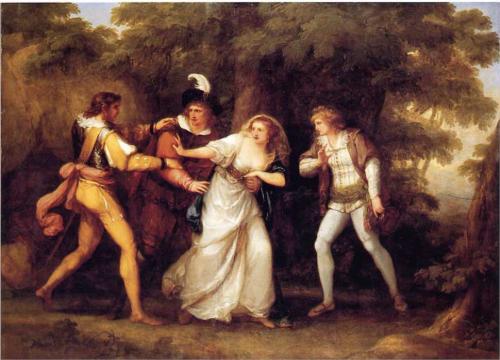
When Silvia flees Milan to the forests outside in search of Valentine, she is captured by outlaws.
From here forward, coincidence and ridiculous changes of heart abound.
All of this unfolds in about 5 pages:
- Proteus rescues Silvia.
- Silvia refuses Proteus’ offers of love.
- Proteus attempts to rape Silvia.
- Valentine, who happens to have assumed the role of king of the outlaws, intervenes and declares Proteus dead to him.
- Proteus apologies.
- Valentine says, abruptly, that all is forgiven. You can have Silvia after all.
- But then the “page boy,” Julia confesses she never delivered the ring to Silvia after all and gives it back to Proteus.
- The ring she hands Proteus, however, is accidentally the ring that he had given her.
- Seeing the ring, and then recognizing Julia (Finally! It’s not like she was wearing Clark Kent glasses), Proteus falls back in love with Julia.
- Valentine, thus, is cleared to marry Sylvia, but for the Duke.
- Except, when Thurio proves to be a coward when Valentine threatens him…
- The Duke decides that Valentine is brave and worthy after all.
- Marriages are implied to ensue.
MY TAKE
On its own, this play would not have made Shakespeare’s career. Being more direct, Harold Bloom calls it the “weakest of all Shakespeare’s comedies” (Invention, 36). But I definitely see many of the elements I most love in Shakespeare present in this play.
Banter, we have banter
First of all, there are the puns and witty banter. It is Shakespeare. That’s what is best here, as when Valentine and Proteus play with boots and shoes:
VALENTINE
That’s on some shallow story of deep love,
How young Leander crossed the Hellespont.PROTEUS
That’s the deep story of a deeper love,
For he was more than over shoes in love.VALENTINE
‘Tis true, for you are over boots in love,
And yet you never swum the Hellespont.PROTEUS
Over the boots? Nay, give me not the boots.VALENTINE
No, I will not, for it boots thee not.
(ACT 1.1 21-28)
Shortly after, Speed and Proteus engage in word play that seems the progenitor of a Noel Coward exchange:
SPEED
The shepherd seeks the sheep, and not the sheep the shepherd; but I seek my master, and my master seeks not me. Therefore I am not sheep.PROTEUS
The sheep for fodder follow the shepherd; the shepherd for food follows not the sheep. Though for wages followest thy master; thy master for wages follows not thee. Therefore thou art a sheep.SPEED
Such another proof will make me cry “baa.”
(ACT 1.1 86-93)
Send in the clowns
Shakespeare has his pairings of high and low characters, with Valentine and Proteus mirrored by Speed and Launce, their “men.” The clowns, as often happens in Shakespeare, win the day.
Launce stands out in the play as something more typical of later plays: his accidental comedy allows you to laugh at him while also sympathizing with him. Launce, Bloom and Garber both argue, is the most Shakespearean of all of the characters. I detected some whiffs of Falstaff in Launce. Launce’s soliloquy about his dog is worth citing here for its transcendence, in prose, of much of the rest of the play:
When a man’s servant shall play the cur with him, look you, it goes hard: one that I brought up of a puppy, one that I saved from drowning where three or four of his blind brothers and sisters went to it. I have taught him, even as one would say precisely, “Thus I would teach a dog.” I was sent to deliver him as a present to Mistress Silvia from my master, and I came no sooner into the dining chamber but he steps me to her trencher and steals her capon’s leg. O, ’tis a foul thing when a cur cannot keep himself in all companies! I would have, as one should say, one that takes upon him to be a dog indeed, to be, as it were, a dog at all things. If I had not had more wit than he, to take a fault upon me that he did, I think verily he had been hanged for’t. You shall judge. He thrusts me himself in to the company of three or four gentleman-like dogs under the duke’s table. He had not been there–bless the mark–a pissing-while but all the chamber smelt him. “Out with the dog,” says one. “What cur is that?” says another. “Whip him out,” says the third. “Hang him up,” says the duke. I, having been acquainted with the smell before, knew it was Crab, and goes me to the fellow that whips the dogs. “Friend,” quoth I, “you mean to whip the dog?” “Ay, marry, do I,” quoth he. “You do him the more wrong,” quoth I; “’twas I did the thing you wot of.” He makes me no more ado, but whips me out of the chamber. How many masters would do this for his servant?
(ACT IV 1-37)
The boy who is a girl who is a boy
Two Gentlemen of Verona launches Shakespeare’s cross-dressing. Dressed as a page boy, Julia creates wonderful moments of tension as she acts as the go-between for Silvia and Proteus. She talks of herself, as Julia the jilted lover, to each.
It’s all always so confusing and fun, knowing that all along the character “Julia” was played by a boy on the Elizabethan stage; so the “putting on” of the page boy outfit and demeanor would have actually meant, for the young actor, shedding the clothes and demeanor of the beautiful woman Julia is supposed to be.
I may be alone among the critics I’ve read in finding Julia to be and interesting and worthy Shakespeare heroine. Her plangent soliloquy in Act 4.4 is more human than almost anything else in the play, colored, I think, by the sympathy for her character that flows from Proteus’ treatment of her.
And I love the poetic despair that emerges in her dialogue with Silvia near the end. When Silvia asks Julia — thinking Julia is a messenger boy — if her rival, Julia, is “not passing fair?” Julia (in her page boy disguise) replies:
She hath been fairer, madam, than she is.
When she did think my master love her well,
She, in my judgment, was fair as you;
But since she did neglect her looking glass
And threw her sun-expelling mask away,
The air hath starved the roses in her cheeks
And pinched the lily-tincture of her face,
That now she is become as black as I.
(ACT IV.4 148-55)
What actress wouldn’t want to recite those lines?
The wrap up
So that’s the great and good in Two Gentlemen of Verona in my view.
But, as I noted above, the ending is a muddle — a rapid tying up of knots (even after Proteus’ attempted rape of Sylvia) that defies my modern ability to suspend disbelief.
Also, for a modern reader, the character of Proteus doesn’t read like a character at all. But I forgive Shakespeare Proteus when I think of Two Gentlemen of Verona‘s closeness in time to the Medieval mystery plays. Proteus is clearly a type, an allegory. He is named for a Greek god of the sea, a symbol for changeable nature. His names gives us the word “protean.”
With that Medieval sensibility in mind, I forgive the ending and the character of Proteus. In that light, I do end up seeing this play as “early” Shakespeare. It still carries the framework of its predecessors in the English drama.
But I have to admit I can’t help but read the play, as many have, as “foreshadowing” Shakespeare’s later greatness as he shed the past and forged a new drama for England.
I’ll leave it at that.
 Shakespeare Year